Wednesday, June 5, 2024

9 reasons for popularity of PM Modi

 Prime Minister Narendra Modi's popularity can be attributed to several factors, ranging from his leadership style to policy initiatives. Here’s an overview of why he is so popular:


1. **Strong Leadership and Charisma:** Modi is often perceived as a decisive and strong leader. His charisma and ability to connect with people across different demographics contribute significantly to his popularity.


2. **Economic Initiatives:** Modi has launched several economic reforms aimed at boosting India’s economy. Initiatives like “Make in India,” “Digital India,” and the implementation of the Goods and Services Tax (GST) have been pivotal. His emphasis on developing infrastructure, promoting entrepreneurship, and attracting foreign investment has resonated with many.


3. **Social Welfare Programs:** Modi has introduced various social welfare schemes targeting the underprivileged, such as the Pradhan Mantri Jan Dhan Yojana (financial inclusion), Pradhan Mantri Ujjwala Yojana (LPG connections to poor households), and Swachh Bharat Abhiyan (Clean India Mission). These initiatives have improved living standards and garnered widespread support.


4. **Nationalism and Security:** Modi’s government has emphasized nationalism and a strong stance on national security. Actions such as the surgical strikes in 2016 and the Balakot airstrike in 2019 have bolstered his image as a protector of national interests, appealing to patriotic sentiments.


5. **Effective Communication:** Modi’s adept use of social media and technology to communicate directly with the public has been a game-changer. His Mann Ki Baat radio program and frequent public addresses help maintain a direct line with citizens.


6. **Political Strategy:** Modi and the Bharatiya Janata Party (BJP) have demonstrated strong organizational skills and electoral strategies. Their ability to mobilize grassroots support and effectively campaign across the country has been a significant factor in electoral successes.


7. **Cultural Resonance:** Modi’s promotion of traditional Indian culture and values, coupled with his own humble beginnings and personal story of rising through the ranks, resonates with many Indians who see him as one of their own.


8. **International Recognition:** Modi’s active foreign policy and efforts to enhance India’s global standing have earned him international recognition. His engagements with world leaders and efforts to attract global investments have further enhanced his domestic popularity.


9. **Crisis Management:** Modi’s handling of crises, such as the COVID-19 pandemic, though not without criticism, has been seen by many as proactive and decisive. Initiatives like the world’s largest vaccination drive and economic relief packages have been pivotal.


These factors collectively contribute to Narendra Modi’s sustained popularity across diverse sections of Indian society, making him a prominent and influential figure in contemporary Indian politics.

History of Elections in India

 The history of elections in India is a testament to the country's commitment to democratic principles since gaining independence. Here’s a comprehensive overview:


1. **Pre-Independence Era:** Before independence in 1947, limited electoral practices existed under British rule. The Government of India Acts of 1919 and 1935 introduced a degree of self-governance, allowing for limited legislative assemblies with restricted electorates.


2. **First General Election (1951-52):** Post-independence, India held its first general election from October 1951 to February 1952. It was the world’s largest democratic exercise at that time, with over 173 million eligible voters. The Indian National Congress (INC), led by Jawaharlal Nehru, emerged victorious.


3. **Establishment of the Election Commission (1950):** The Election Commission of India (ECI) was established on January 25, 1950, to oversee and ensure free and fair elections across the country. It plays a pivotal role in administering electoral processes.


4. **Evolution and Expansion:** Over the decades, the election process has evolved significantly. The number of eligible voters has grown exponentially, with every adult citizen above 18 years having the right to vote. The ECI introduced various reforms to improve transparency, such as the use of Electronic Voting Machines (EVMs) in 1999.


5. **Major Elections and Shifts:**

   - **1967 General Election:** Marked by significant political shifts, it saw the emergence of regional parties and a decrease in the dominance of the INC.

   - **1977 General Election:** Held after the Emergency period (1975-77), this election resulted in the first non-Congress government led by the Janata Party.

   - **1984 General Election:** Held in the wake of Prime Minister Indira Gandhi’s assassination, the INC, led by Rajiv Gandhi, won a landslide victory.

   - **1990s:** The rise of coalition politics became prominent, with no single party gaining an outright majority. This era saw the emergence of significant regional parties and the formation of coalition governments.


6. **Modern Reforms:** The ECI has continually introduced reforms to enhance the electoral process, including:

   - **Introduction of Voter-Verified Paper Audit Trail (VVPAT):** Added to EVMs to increase transparency and voter confidence.

   - **NOTA (None of the Above):** Introduced in 2013, allowing voters to reject all candidates if they choose.

   - **Electoral Roll Digitization:** Enhancing accessibility and accuracy of voter lists.


7. **Recent Elections:** The 2014 and 2019 general elections witnessed significant voter turnout and the rise of the Bharatiya Janata Party (BJP) under the leadership of Narendra Modi, resulting in decisive victories.


8. **Continuous Evolution:** India's electoral history is characterized by its adaptability and resilience, continuously evolving to meet the needs of its diverse and growing electorate.


This historical journey underscores India's robust democratic framework, reflecting the nation's commitment to upholding democratic values and ensuring every citizen's voice is heard through the electoral process.

Process of Elections in India

 Elections in India are conducted in a systematic and structured manner to ensure free and fair voting. Here’s an overview of the process:


1. **Election Commission of India (ECI):** The ECI is an autonomous constitutional authority responsible for administering election processes at the national, state, and local levels. It ensures elections are conducted impartially and efficiently.


2. **Electoral Rolls:** A comprehensive list of eligible voters is prepared and updated regularly. Citizens aged 18 and above are eligible to vote, provided they are registered.


3. **Notification and Schedule:** The ECI announces the election schedule, which includes the dates for filing nominations, scrutiny, withdrawal of candidatures, polling, counting of votes, and declaration of results.


4. **Nominations:** Candidates file their nominations with the appropriate Returning Officer. These nominations are scrutinized to ensure candidates meet all eligibility criteria.


5. **Campaigning:** Political parties and candidates campaign extensively across constituencies. The ECI enforces a Model Code of Conduct to ensure campaigns are fair and free of malpractices.


6. **Polling:** Polling is conducted in multiple phases to ensure adequate security and administration. Polling booths are set up across the country, equipped with Electronic Voting Machines (EVMs) and Voter-Verified Paper Audit Trails (VVPATs).


7. **Security:** Security measures are stringent to prevent electoral fraud and violence. Central and state police forces are deployed to maintain order.


8. **Voting Process:** On the day of the election, voters cast their votes at designated polling stations. They must present valid identification and their names must appear on the electoral roll.


9. **Counting of Votes:** After polling concludes, votes are counted under strict supervision. The EVMs and VVPATs are used to tally votes accurately.


10. **Declaration of Results:** Results are declared by the ECI. The candidate with the majority of votes in each constituency is declared the winner.


11. **Post-Election:** Winning candidates take their oaths of office and assume their respective positions in government.


This structured process ensures that elections in India are conducted transparently, giving citizens the opportunity to participate in the democratic process.

Saturday, May 25, 2024

Major Laws and Rights


🔹 Motor Vehicle Act 1988, section -185, 202

➨ At the time of driving if your 100ml. blood contains more than 30mg. of alcohol then the police can arrest you without a warrant.


🔹 Criminal Procedure Code, Section 46

➨ No woman cannot be arrested before 6 A.M. and after 6 P.M.


🔹 Indian Penal Code, 166 A

➨ A Police officer can’t refuse to lodge an FIR if he/she does so they could be jailed for up to 6 months to 1 year.


🔹 Indian Sarais Act, 1887

➨ Even any 5-star hotel can’t prohibit you from drinking potable water and using its washrooms.


🔹 Motor Vehicle Act, 1988

➨ As per Section 129 of the Indian Motor Vehicle Act, wearing the helmet is a must for two-wheeler riders. Section 128 of this Motor Vehicle Act limits the maximum two riders on the bikes.


🔹 Domestic Violence Act, 2005

➨ If a young boy and a girl want to live together in a “live-in relationship”, they can do so because it is not illegal. Even the newborn from this relationship is also a legal son or daughter and this newborn have the full right in the assets of his/her father.


🔹 Police Act, 1861

➨ A police officer is always on duty whether he/she wearing a uniform or not. If a person makes a complaint to the officer, he/she could not say that he can’t help the victim because he/ she is not on duty.


🔹 Maternity Benefit Act, 1961

➨ No company can fire a pregnant woman. It may be punishable by a maximum of 3 years of imprisonment. If the company (Government or private) has more than 10 employees then the pregnant women employee is eligible to get 84 days paid maternity leave.


🔹 Income Tax Act, 1961

➨ In the case of tax violations, the tax collection officer has the power to arrest you but before arresting you, he/she will have to send a notice to you. Only Tax Commissioner decides how long you will stay in the custody.


🔹 Hindu Marriage Act, 1955 (Section -13)

➨ As per the Hindu Marriage Act, 1955 (any husband or wife) may apply for divorce in the court on the basis of Adultery (physical relationship outside of marriage), physical and mental abuse, impotency, to leave home without information, to change Hindu religion and adopt other religion, insanity, incurable disease and no information about husband or wife for seven-year.


🔹 Code of Criminal Procedure, 1973

➨ Only women police constable can arrest women.  Male constable doesn’t have the right to arrest women. Women have the right to deny going to police stations after the 6 P.M. and before the 6 A.M. In the case of a serious crime only after receipt of the written order from the magistrate, a male policeman can arrest a woman.


🔹 As per the Citizen Charter (Indian Oil Corporation website)

➨ There are very few people who know that if their gas cylinder blasts during the cooking of food then the gas agency is liable to pay Rs. 50 lakh to the victim as compensation. To claim this compensation consumers need to lodge an FIR to the nearest police station and submit it to the concerned gas agency.


🔹 Automotive (Amendment) Bill, 2016

➨ If you are fined for a crime (like riding without a helmet or any other reason) then you will not be fined for the same reason in the same day.


🔹 Maximum Retail Price Act, 2014

➨ Any Shop keeper can’t charge more than the printed price of any commodity but a consumer has the right to bargain for less than the printed price of a commodity.


🔹 Limitation Act, 1963

➨ If your office does not pay you then you have the power to file an FIR against it within 3 years. But if you report after 3 years, you will not get anything for the due.


🔹 Section 294 of the Indian Penal Code

➨ If you are found involved in “obscene activity" at a public place, you can be imprisoned for 3 months. But in the absence of an exact definition of obscene activity police have always misused this act.


🔹 Hindu Adoption and Maintenance Act, 1956

➨ If somebody belongs to the Hindu religion and has a son or grandson then he can’t adopt a second child.

Friday, May 3, 2024

The three judges cases of India

The "Three Judges Cases" in India are a series of landmark judicial decisions that significantly impacted the appointment and transfer of judges in the country. These cases played a crucial role in defining the principles of judicial independence, separation of powers, and the collegium system in India's judiciary. Here are the details of each case:

1. **S. P. Gupta v. Union of India (First Judges Case) - 1981:**
   - **Background:** The case revolved around the interpretation of Article 124 of the Indian Constitution, which deals with the appointment of Supreme Court judges. The government's power to appoint judges was challenged.
   - **Decision:** The Supreme Court held that the opinion of the Chief Justice of India (CJI) in judicial appointments should be given primacy. However, the CJI's opinion should be formed in consultation with a collegium of four senior-most judges of the Supreme Court.
   - **Significance:** This case established the collegium system, where judges have a significant say in judicial appointments.

2. **Supreme Court Advocates-on-Record Association v. Union of India (Second Judges Case) - 1993:**
   - **Background:** This case dealt with the interpretation of Article 124 and the role of the CJI in judicial appointments. The government's power to appoint judges was again challenged.
   - **Decision:** The Supreme Court ruled that the CJI should consult a collegium consisting of four senior-most judges of the Supreme Court in judicial appointments. The CJI's opinion, along with the collegium's recommendation, should be determinative.
   - **Significance:** This case reaffirmed and clarified the collegium system, emphasizing the independence of the judiciary from executive interference in appointments.

3. **Special Reference No. 1 of 1998 (Third Judges Case) - 1998:**
   - **Background:** The President of India referred questions regarding the appointment of Supreme Court judges to the Supreme Court for its opinion, leading to this case.
   - **Decision:** The Supreme Court reiterated and expanded on the collegium system. It held that the CJI's opinion, along with the collegium's recommendation, should be binding on the government in judicial appointments and transfers.
   - **Significance:** This case solidified the collegium system as the primary method for judicial appointments and transfers, further strengthening judicial independence.

These three cases collectively established the collegium system, which gives significant autonomy to the judiciary in the appointment and transfer of judges, aiming to ensure judicial independence and uphold the separation of powers between the judiciary and the executive in India.

Due process vs Procedure established by law

In India, due process and procedure established by law are two distinct legal concepts that ensure fairness and justice, but they operate differently.

1. **Due Process:**
   - **Definition:** Due process refers to the principle that the government must respect all legal rights owed to a person according to the law.
   - **Application:** It ensures that individuals have the right to a fair trial, legal representation, and protection against arbitrary or unfair government actions.
   - **Example:** In the Indian context, Article 21 of the Constitution guarantees the right to life and personal liberty. The Supreme Court of India has interpreted this to include the right to a fair trial, legal aid, and protection against arbitrary arrest or detention.

2. **Procedure Established by Law:**
   - **Definition:** This concept means that any action taken by the government must follow procedures laid down by law, regardless of whether they are fair or just.
   - **Application:** It focuses on the legality of the procedure rather than its fairness. If a law permits a certain action, it can be carried out even if it seems unfair.
   - **Example:** The controversial Prevention of Terrorism Act (POTA) in India was considered legal and enforceable because it was established by law, despite criticism that it compromised civil liberties.

In essence, due process emphasizes the protection of individual rights and ensures fairness, while procedure established by law focuses on the legality of government actions according to existing laws, even if those laws are deemed unfair or unjust by some.

Saturday, April 27, 2024

UN and it's principal organs

The United Nations (UN) is an international organization founded on October 24, 1945, after World War II, to promote international cooperation and prevent future conflicts. Its principal organs include:

1. **General Assembly (GA):** Comprising all 193 member states, the GA is the main deliberative, policymaking, and representative organ of the UN. It meets annually in regular sessions and can convene emergency sessions if needed.

2. **Security Council (SC):** Responsible for maintaining international peace and security, the SC has 15 members, including five permanent members with veto power (China, France, Russia, the United Kingdom, and the United States) and ten non-permanent members elected for two-year terms.

3. **Secretariat:** Headed by the Secretary-General, the Secretariat provides administrative support to UN activities, implements decisions, and manages programs and projects around the world. The Secretary-General is the chief administrative officer of the UN.

4. **International Court of Justice (ICJ):** The principal judicial organ of the UN, located in The Hague, Netherlands. It settles legal disputes between states and gives advisory opinions on legal questions referred by authorized UN organs and specialized agencies.

5. **Economic and Social Council (ECOSOC):** Coordinates economic, social, and related work of 15 UN specialized agencies, their functional commissions, and five regional commissions. It has 54 members elected by the GA for three-year terms.

6. **Trusteeship Council:** Initially tasked with supervising trust territories, the Council suspended operations in 1994 after successfully completing its main mandate. It meets as needed and is authorized to meet on the decision of the Security Council or the General Assembly.

7. **International Monetary Fund (IMF) and World Bank Group:** Although not formal UN organs, they collaborate closely with the UN on international economic issues. The IMF aims to foster global monetary cooperation, while the World Bank Group focuses on poverty reduction and development.

These organs work together to address a wide range of global issues, including peace and security, human rights, humanitarian aid, sustainable development, climate change, and international law.

Sunday, April 21, 2024

Important Parliamentary Terms


A

"Act (of Parliament)" - In India, a Bill passed by the two Houses of Parliament and assented to by the President.

"Address (President's/Presidential)" - A prepared speech delivered by the President of India to both Houses of Parliament assembled together at the commencement of the first session of each year informing Parliament of the causes of its summons which is later laid before and discussed on a formal Motion of Thanks in each House of Parliament or an address by the President of India to either House of Parliament or both Houses assembled together on any other occasion. The Council of Ministers approves the text of the President's Address and is responsible for its contents.

"Adjournment of the House" - Suspend (proceedings) for the day; to put off until a future day. The word 'Adjourn' applies to the action of a deliberative body etc. in bringing a sitting to a close, with the intention of resuming on the next working day or a specified later date. In Lok Sabha, the Speaker determines when sitting of House is to adjourn sine die or to a particular day or to an hour or part of same day.

"Adjournment Motion" - A Motion for discussing 'a specific and important matter that should have urgent consideration'. It can be moved by any member of the House and is in the nature of emergency motion of censure upon the Government. The object is to draw the attention of the Government to a matter of urgent public importance so as to criticize the decision of Government in an urgent matter in regard to which a motion or resolution with proper notice will be too late.

"Admonition" - A punishment administered by the Presiding Officer of a legislature to an offender for breach of privilege or contempt of the House in case of an offence which is not so grave as to warrant his committal; it is the mildest form of punishment.

"Affirmation" - A positive declaration; a solemn declaration without oath; a solemn declaration made by a member of a legislature in lieu of oath before he takes his seat in the House. "I, A.B., having been elected a Member of the House of the People do solemnly affirm that I will bear true faith and allegiance to the Constitution of India as by law established, that I will uphold the sovereignty and integrity of India and that I will faithfully discharge the duty upon which I am about to enter."

"Allocation of Time" - In India, the practice is that all items of business to be transacted by the House during the Government time including those to which the Speaker is empowered to allot time himself, are normally placed before the Business Advisory Committee for allocation of time. The report of the Business Advisory Committee is presented to House for approval after which the allocation of time in respect of Bills and other business becomes an order of the House.

"Amendment(s)" - A device to alter a motion moved or question under discussion in the Legislature; includes omission, substitution, addition and insertion of certain words, figures or marks to the clause of a bill, a resolution or a motion or to an amendment made thereof.

"Annual Financial Statement" - A statement made by the Minister incharge of Finance in the legislature containing the probable income and expenditure of the Government for any year; familiarly known as Budget.

"Answers (to questions)" - In the Indian Parliament, oral answers are given to Questions distinguished by an asterisk while those not distinguished by an asterisk are listed for written answers; supplementary questions are asked for further elucidating any matter of fact regarding which an answer has been given, if permitted by the Speaker. Normally the first hour of every sitting is allotted for answering questions.

B

"Bill(s)" - A draft of a legislative proposal put in the proper form which when passed by both the Houses of Parliament and assented to by the President becomes an Act.

"Breach of Privilege" - Disregard of any of the privileges, rights and immunities either of the Members of Parliament individually or of either House of Parliament in its collective capacity or of its committees; also includes actions which obstruct the House in the performance of its functions and thereby lower its dignity and authority such as disobedience of its legitimate orders or libel upon itself, or its member or officers which are called contempt of the House (for details see 'Privileges').

"Business, list of" - In the Indian Parliament, it is known as List of Business, prepared under the authority of the Speaker by the Secretary-General and a copy thereof is supplied to every member; contains the items of business, Govt. and Private members', scheduled to be taken up on a particular day; the first item generally is Questions; Oath or affirmation and obituary reference, whenever listed, precede Questions; List of Questions though part of List of Business, is issued separately; List of Business, the List of Questions, the List of Amendments, cut-motions and the Bills, all combined form the Order Paper for the day.

"Business of the House" - The relative order of all the items of business in the House of a Legislature to be taken up on a particular day. Government Business for a whole week is announced in advance in the House by the Minister for Parliamentary Affairs.

C

"Calling Attention" - The act of requiring somebody to give his attention to; to point out; a parliamentary procedure to call the attention of the Government to a matter of urgent public importance.

"Censure Motion" - A motion moved against the Government censuring its policy in some direction or an individual minister or ministers of the Government.

"Commonwealth Parliamentary Association" - The Commonwealth Parliamentary Association is an organisation composed of Branches formed in the legislatures of various Commonwealth countries. It consists of main Branches formed in the National Parliaments of Commonwealth, State and Provincial branches formed in State or Provincial Legislatures within member countries of the Commonwealth and territorial Parliaments.

"Concurrent List" - A list of subjects appended to a federal Constitution in respect of which the federal legislature and the State or regional legislatures have power to make laws, federal law prevailing in case of conflict.

"Constitution" - The system of fundamental laws and principles of a government written or unwritten; system of laws and customs established by sovereign power of a State for its own guidance.

"Contempt of the House" - Any act or omission which obstructs or impedes either House of Parliament in the performance of its functions, or which obstructs or impedes any member or officer of such House in the discharge of his duty, or which has a tendency, directly or indirectly, to produce such results is treated as a contempt even though there is no precedent of the offence.

"Cut Motions" - During the discussion on the demands for grants, motion can be moved to reduce the amount of a demand; such a motion is called cut motion.

D

"Delegated Legislation" - "Delegated legislation" and "delegation of legislative power" is the conferring of authority upon a subordinate authority to frame rules, regulations etc. Each regulation, rule, sub-rule, bye-law etc. framed in pursuance of the provisions of the Constitution or Act of Parliament under the power delegated thereunder to a subordinate authority is required to be laid on the Table of Lok Sabha within a period of fifteen days after publication in the Gazette.

"Deputy Speaker" - Deputy Speaker is elected from amongst its members; he is not subordinate to the Speaker and holds an independent position; he is answerable to the House alone. In the absence of the Speaker, the Deputy Speaker is required to perform the duties of the Office of the Speaker and preside over the sitting of the House and also the joint sitting of the Houses of Parliament and exercises the powers of the Speaker.

"Directive Principles of State Policy" - Constitutional directions and principles fundamental in the governance of the country.

"Dissolution" - The President of India dissolves the Lok Sabha on the advice of the Prime Minister. At the end of its term of five years, the House stands automatically dissolved even if no formal order of dissolution is issued by the President. With dissolution, the life of the House comes to an end and it cannot again assemble until after a general election. Dissolution 'passes a sponge over the Parliamentary slate' and all business pending before it or any of its committees lapses on dissolution.

"Disqualifications for" - Constitutional or statutory rules which make a person unfit or unqualified to be chosen as member of a Legislature; also those which make a member unfit for being its member subsequent to his election.

"Division" - Division is ordered by the Chair when his opinion on the question just decided by voice vote is challenged by members who demand a division.

E

"Election Commission" - A constitutional body in India created for the purpose of holding elections to Parliament, State Legislatures and offices of President and Vice-President.

"Electoral College" - An intermediary body chosen by electors to choose the representatives in an indirect election.

"Enacting Formula" - The section of a Bill or statute which establishes the whole document as a law.

G

"Government" - A Parliamentary government consists of cabinet which is responsible to the legislature for its actions. Government carries on general administration and Parliament exercises general control of governmental acts.

"Government Assurances" - Assurances, promises, undertakings given by Ministers from time to time on the Floor of the House; for ensuring their implementation in reasonable time.

H

"Houses of Parliament" - The two Houses of Indian Parliament are: the Rajya Sabha (Council of States) and the Lok Sabha (House of the People).

"Hung Parliament" - Parliament wherein no party has won a working majority

L

"Leader of the House" - In Lok Sabha, the Prime Minister usually functions as the Leader of the House; if he is not a member of this House, a Minister, who is a member of the Lok Sabha and is nominated by the Prime Minister functions as such. Leader of the House is an important Parliamentary functionary.

"Leader of Opposition" - Leader of the largest minority party in a legislature; an office recognised under the Rules of the House.

"Leave of Absence" - The formal granting of leave of absence to a Member of Parliament.

"Leave of the House" - The formal approval given by the House of a Legislature to a member to move a motion or withdraw the same. The member can seek the leave of the House only after he has been permitted to do so by the Speaker; he then rises in his place and asks for leave. After the leave is granted, the member cannot withdraw his motion without the permission of the House.

"Legislation (Subordinate)" - Making of statutory instruments or orders by a body subordinate to the legislature in exercise of the power within specific limits conferred by the legislature; also covers statutory instruments themselves.

M

"Maiden Speech" - M.P.'s first speech in Parliament; one's first or earliest speech, especially in Parliament.

O

"Office of Profit" - An employment with fees and emoluments attached to it; it also carries some power of patronage; the holder of it is entitled to exercise executive, financial or judicial powers.

"Ordinance" - The President of the Union and the Governors of the States have legislative power to promulgate Ordinances, such power is co-extensive with the legislative competence of Parliament.

P

"Panel of Chairmen" - The body of members whom the Speaker nominates from among the members to preside over the sittings of the House in the absence of the Speaker and the Deputy Speaker.

"Papers laid on the Table" - Laying of Parliamentary papers or documents on the Table of both Houses of Parliament for bringing them on the record of the House.

"Parliament—Jurisdiction and Powers of" - Parliament consists of the President and the two Houses; each of its branches has peculiar powers in connection with their joint legislative function.

"Parliamentary Papers" - The papers connected with the proceedings of the House as well as those presented to the House; the copies of these papers are made available to the Members as soon as they are issued.

R

"Rules of Procedure" - Rules which regulate procedure, debate and the conduct of members in a Legislature.

S

"Schedule" - The Schedule is as much a part of the statute and as much an enactment as any other part; it must be read together with the Act for all purpose of construction.

"Select Committee on Bill(s)" - A Parliamentary Committee composed of members specially named and appointed from time to time to consider, inquire into or deal with Bills.

"Speaker" - The Speaker is the Principal Presiding Officer of the Lok Sabha. He is chosen by the House from among its Members by a simple majority of members present and voting. Within the walls of the House his authority is supreme, which is based on his absolute and unvarying impartiality.

"Speaker pro tem" - A member of a Legislative House appointed to perform the duties of the Office of the Speaker when the offices of both the Speaker and Deputy Speaker are vacant; the Speaker pro tem continues in office till the Speaker is elected.

T

"Table of the House" - In the pit of the two Houses of Indian Parliament, just in front of the table of the Secretary-General lies the table of the House. Papers which are required to be laid on the Table of the House in pursuance of constitutional provisions, Rules and Directions are formally placed on this Table.

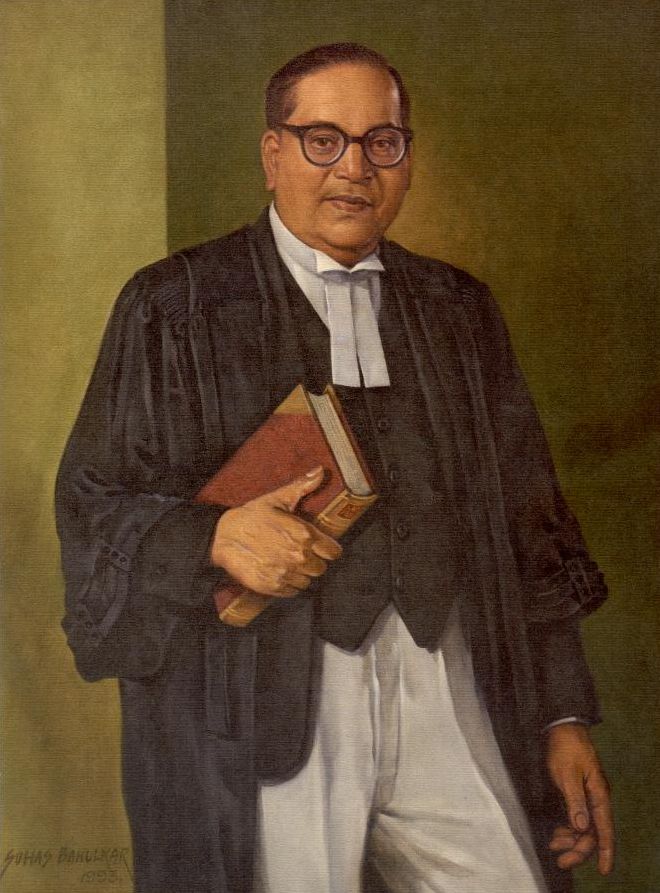
Dr. Bhimrao Ramji Ambedkar

Dr. Bhimrao Ramji Ambedkar 

Photo Credit : High Court of Bombay

Dr. Bhimrao Ramji Ambedkar (1891-1956) was born on 14 April 1891 in Mhow Cantonment, Madhya Pradesh. He completed his primary schooling in Satara, Maharashtra and completed his secondary education from Elphinstone High School in Bombay. His education was achieved in the face of significant discrimination, for he belonged to the Scheduled Caste (then considered as ‘untouchables’). In his autobiographical note ‘Waiting for a Visa’, he recalled how he was not allowed to drink water from the common water tap at his school, writing, "no peon, no water".

Dr Ambedkar graduated from Bombay University in 1912 with a B.A. in Economics and Political Science. On account of his excellent performance at college, in 1913 he was awarded a scholarship by Sayajirao Gaikwad, then Maharaja (King) of Baroda state to pursue his M.A. and Ph.D. at Columbia University in New York, USA. His Master's thesis in 1916 was titled “The Administration and Finance of the East India Company”. He submitted his Ph.D. thesis on “The Evolution of Provincial Finance in India: A Study in the Provincial Decentralization of Imperial Finance”.

After Columbia, Dr. Ambedkar moved to London, where he registered at the London School of Economics and Political Science (LSE) to study economics, and enrolled in Grey’s Inn to study law. However, due to lack of funds, he had to return to India in 1917. In 1918, he became a Professor of Political Economy at Sydenham College, Mumbai (erstwhile Bombay). During this time, he submitted a statement to the Southborough Committee demanding universal adult franchise.

In 1920, with the financial assistance from Chatrapati Shahuji Maharaj of Kolhapur, a personal loan from a friend and his savings from his time in India, Dr. Ambedkar returned to London to complete his education. In 1922, he was called to the bar and became a barrister-at-law. He also completed his M.S.c. and D.S.c. from the LSE. His doctoral thesis was later published as “The Problem of the Rupee”.

After his return to India, Dr Ambedkar founded Bahishkrit Hitkarini Sabha (Society for Welfare of the Ostracized) and led social movements such as Mahad Satyagraha in 1927 to demand justice and equal access to public resources for the historically oppressed castes of the Indian society. In the same year, he entered the Bombay Legislative Council as a nominated member.

Subsequently, Dr. Ambedkar made his submissions before the Indian Statutory Commission also known as the ‘Simon Commission’ on constitutional reforms in 1928. The reports of the Simon Commission resulted in the three roundtable conferences between 1930-32, where Dr. Ambedkar was invited to make his submissions.

In 1935, Dr. Ambedkar was appointed as the Principal of Government Law College, Mumbai, where he was teaching as a Professor since 1928. Thereafter, he was appointed as the Labour Member (1942-46) in the Viceroy’s Executive Council.

In 1946, he was elected to the Constituent Assembly of India. On 15 August 1947, he took oath as the first Law Minister of independent India. Subsequently, he was elected Chairperson of the Drafting Committee of the Constituent Assembly, and steered the process of drafting of India’s Constitution. Mahavir Tyagi, a member of the Constituent Assembly, described Dr. Ambedkar as “the main artist” who “laid aside his brush and unveiled the picture for the public to see and comment upon”. Dr. Rajendra Prasad, who presided over the Constituent Assembly and later became the first President of the Indian Republic, said: “Sitting in the Chair and watching the proceedings from day to day, I have realised as nobody else could have, with what zeal and devotion the members of the Drafting Committee and especially its Chairman, Dr. Ambedkar in spite of his indifferent health, have worked. We could never make a decision which was or could be ever so right as when we put him on the Drafting Committee and made him its Chairman. He has not only justified his selection but has added luster to the work which he has done.”

After the first General Election in 1952, he became a member of the Rajya Sabha. He was also awarded an honorary doctorate degree from Columbia University in the same year. In 1953, he was also awarded another honorary doctorate from Osmania University, Hyderabad.

Dr. Ambedkar's health worsened in 1955 due to prolonged illness. He passed away in his sleep on 6 December 1956 in Delhi.

References:
  • Vasant Moon (eds.), Dr. Babasaheb Ambedkar Writings And Speeches, (Dr. Ambedkar Foundation, Ministry of Social Justice & Empowerment, Govt. of India, 2019) (Re-print)
  • Dhananjay Keer, Dr. Ambedkar Life and Mission, (Popular Prakashan, 2019 Re-print)
  • Ashok Gopal, A Part Apart: Life and Thought of B.R. Ambedkar, (Navayana Publishing Pvt. Ltd., 2023)
  • Narendra Jadhav, Ambedkar: Awakening India's Social Conscience, (Konark Publishers Pvt. Ltd., 2014).
  • William Gould, Santosh Dass and Christophe Jaffrelot (eds.), Ambedkar In London, (C. Hurst and Co. Publishers Ltd., 2022).
  • Sukhadeo Thorat and Narender Kumar, B.R. Ambedkar: Perspectives on Social Exclusion and Inclusive Policies (Oxford University Press, 2009).
  • Constituent Assembly Debates

The Kesavananda Bharati case final judgement

 The Kesavananda Bharati case has been hailed as a landmark in the history of Indian constitutional law as it affirmed the supremacy of the Constitution and the independence of the judiciary in protecting the basic structure of the Constitution. The judgment laid down several principles that have become the bedrock of constitutional law in India. These include the principles of the rule of law, separation of powers, and the independence of the judiciary.It has also been instrumental in shaping the Indian judiciary's approach to constitutional interpretation and the limits of Parliament's power to amend the Constitution.

Video link: https://youtu.be/oUsgmhhmr2Q 
The Supreme Court, in a 7-6 majority decision, held that the Constitution of India has a basic structure that cannot be altered even by a constitutional amendment. The court held that the Parliament's amending power under Article 368 is not unlimited and that it cannot alter the basic structure of the Constitution. This has served as an important check on the power of the Parliament to amend the Constitution.

Distinction between "due process of law" and "procedures established by law"

The distinction between "due process of law" and "procedures established by law" lies in their scope, implications, and ...