Sunday, April 21, 2024

The Kesavananda Bharati case involved several key legal issues,

 The Kesavananda Bharati case involved several key legal issues, including the constitutional validity of the Kerala Land Reforms Act and the extent of the Parliament's power to amend the Constitution.

Constitutional Validity of the Kerala Land Reforms Act: The primary legal issue in the case was the constitutional validity of the Kerala Land Reforms Act, which placed a limit on the amount of land that a person could hold and provided for the acquisition of excess land from landowners. Kesavananda Bharati argued that the Act violated his fundamental right to property, which was guaranteed by the Constitution of India.

The extent of the Parliament's power to amend the Constitution: Another key legal issue in the case was the extent of the Parliament's power to amend the Constitution. The question before the Supreme Court was whether the Parliament's power to amend the Constitution was unlimited or whether there were limits to this power.

The doctrine of basic structure of the Constitution: The Supreme Court, in its judgment, established the doctrine of basic structure of the Constitution, which holds that certain fundamental features of the Constitution, such as the supremacy of the Constitution, the rule of law, and the independence of the judiciary, cannot be amended or abrogated by the Parliament through a constitutional amendment. The question before the court was whether this doctrine was a part of the Constitution and whether the Parliament's power to amend the Constitution extended to this doctrine.

The key legal issues involved in the Kesavananda Bharati case were the constitutional validity of the Kerala Land Reforms Act, the extent of the Parliament's power to amend the Constitution, and the establishment of the doctrine of basic structure of the Constitution.

Background information on Kesavananda Bharati and its origins

 The origins of the Kesavananda Bharati case can be traced back to the land reforms that were introduced in the Indian state of Kerala in the 1950s and 1960s. These reforms were aimed at redistributing land from large landowners to the landless and the poor. In 1963, the Kerala government passed the Kerala Land Reforms Act, which placed a limit on the amount of land that a person could hold. The Act provided for the acquisition of excess land from landowners and its distribution to the landless and the poor.

Sri Kesavananda Bharati was the head or pontiff of the Edneer Mutt, a Hindu religious institution in Kerala, India. In 1970, the Government of Kerala imposed restrictions on the ownership of land held by religious institutions. The Edneer Mutt, headed by Sri Kesavananda Bharati, challenged the constitutionality of the Act in the Kerala High Court. The case eventually reached the Supreme Court, which ruled in favour of the state government.

The Parliament of India in the meantime passed the 24th Amendment to the Constitution, which sought to curtail the powers of the judiciary and limit the scope of judicial review. The 25th and 29th Amendments were also passed, which sought to limit the fundamental rights of citizens and give Parliament the power to amend any part of the Constitution.

Sri Kesavananda Bharati filed a petition challenging the validity of these amendments, arguing that they violated the basic structure of the Constitution. This led to the landmark Kesavananda Bharati judgment, which upheld the basic structure doctrine and placed limits on the power of the Parliament to amend the Constitution.

The case became one of the most important case in Indian constitutional history, and Sri Kesavananda Bharati is remembered as a key figure in the fight to uphold the principles of democracy and the rule of law in India.

Introduction to the Judgment

The Kesavananda Bharati judgment, delivered on 24 April 1973, is a landmark judgment of the Supreme Court of India. The case was filed by Sri Kesavananda Bharati, the head of a Hindu religious mutt in Kerala, challenging the constitutional validity of the 24th, 25th and 29th Amendments to the Indian Constitution, which sought to curtail the powers of the judiciary and the fundamental rights of citizens.


The Kesavananda Bharati case was heard by a bench of 13 judges of the Supreme Court of India, making it one of the largest benches in Indian legal history. The bench comprised of Chief Justice S. M. Sikri, Justice J.M.Shelat, Justice K.S. Hegde, Justice A.N.Grover, Justices A.N. Ray, Justice P. Jaganmohan Reddy, Justice D.G. Palekar, Justice H.R. Khanna, Justice K.K. Mathew, Justice M.H. Beg, Justice S.N. Dwivedi, Justice A.K. Mukherjee and Justice Y.V. Chandrachud.

The bench was set up to hear the case as it involved important constitutional questions regarding the powers of the Parliament to amend the Constitution. The bench took six months to hear the arguments and deliver the final judgment.

The Supreme Court, in a historic 7:6 majority decision, propounded the basic structure doctrine of the Constitution, which holds that certain fundamental features of the Constitution, such as democracy, secularism, federalism, and the rule of law, cannot be amended by parliament. The court also held that the power of judicial review is an integral part of the basic structure of the Constitution, and cannot be taken away by Parliament through constitutional amendments.

The significance of the Kesavananda Bharati case lies in the fact that it established the doctrine of basic structure of the Indian Constitution. The basic structure doctrine holds that certain fundamental features of the Constitution, such as the supremacy of the Constitution, the rule of law, and the independence of the judiciary, cannot be amended or abrogated by the Parliament through a constitutional amendment.

This doctrine has served as a check on the power of the Parliament to amend the Constitution and has ensured that the Constitution remains a living document that is responsive to changing times while preserving its fundamental values and principles. The Kesavananda Bharati case has thus had far-reaching consequences for the constitutional development of India, making it one of the most significant cases in Indian constitutional law.

PRECURSORS TO KESAVANANDA BHARATI JUDGEMENT

 A.K. Gopalan v. The State of Madras, Sri Sankari Prasad Singh Deo v. Union of India and State of Bihar, Sajjan Singh v. State of Rajasthan, and I.C. Golak Nath & Ors. v. State of Punjab & Anrs. are all landmark cases and significant precedents in the history of Indian constitutional law.

A.K. Gopalan v. The State of Madras (1950) dealt with the constitutionality of preventive detention laws. The Supreme Court upheld the constitutionality of such laws, holding that the fundamental rights guaranteed under the Indian Constitution, including the right to life and personal liberty, were not absolute and could be curtailed by the state for reasons of national security.

Sri Sankari Prasad Singh Deo v. Union of India and State of Bihar (1951) dealt with the power of the Parliament to amend the Constitution. The Supreme Court held that the power to amend the Constitution under Article 368 was absolute and unfettered, and that the validity of a constitutional amendment could not be questioned on the ground that it violated any fundamental rights guaranteed under the Constitution.

Sajjan Singh v. State of Rajasthan (1965) dealt with the Constitutional validity of the 17th Constitutional Amendment. The Supreme Court upholding the validity of the 17th Amendment held that the Parliament has the authority to amend any part of the Constitution including any Fundamental Rights. The Supreme Court in the Judgement even stated that if the Constitution makers intended to exclude the fundamental Right from the scope of amending power they would have made a clear provision in that behalf.

I.C. Golak Nath & Ors. v. State of Punjab & Anrs. (1967) dealt with the power of the Parliament to amend the Constitution. The Supreme Court, in a landmark judgment, held that the power to amend the Constitution under Article 368 was not unlimited and that the fundamental rights guaranteed under the Constitution could not be abrogated or abridged by a constitutional amendment

These cases are important as they helped in shaping the interpretation of the fundamental rights guaranteed under the Indian Constitution and the power of the Parliament to amend the Constitution. They also established the groundwork for subsequent cases, including Kesavananda Bharati, which has a lasting impact on the Indian legal system.

History of Supreme Court of India


The Supreme Court of India is the apex judicial body under the Constitution of India. Article 124 of the Constitution states that “There shall be a Supreme Court of India.” The Supreme Court came into existence on 26 January 1950 with the coming into force of the Constitution. The Supreme Court initially functioned from the old Parliament House till it moved to the present building located on Tilak Marg, New Delhi in 1958.

On 28 January 1950, two days after India became a Sovereign Democratic Republic, the Supreme Court was inaugurated. The inauguration took place in the Chamber of Princes in the old Parliament building where the Federal Court of India sat for 12 years from 1937 to 1950.

The inaugural proceedings began at 9:45 am. It was attended by the first Chief Justice of India, Harilal J. Kania and Judges of the Federal Court – Justices Saiyid Fazl Ali, M. Patanjali Sastri, Mehr Chand Mahajan, Bijan Kumar Mukherjea and S.R. Das, the Chief Justices of the High Courts of Allahabad, Bombay, Madras, Orissa, Assam, Nagpur, Punjab, Saurashtra, Patiala and the East Punjab States Union, Mysore, Hyderabad, Madhya Bharat and Travancore-Cochin.
The proceedings were also graced by the Prime Minister of India, ambassadors and diplomatic representatives of foreign States, the Attorney General of India M.C. Setalvad, the Advocate Generals of Bombay, Madras, Uttar Pradesh, Bihar, East Punjab, Orissa, Mysore, Hyderabad, and Madhya Bharat and a large number of advocates. To ensure that the Rules of the Supreme Court were published and the names of all the Advocates and agents of the Federal Court were brought on the rolls of the Supreme Court, the inaugural proceedings were put as part of the record of the Supreme Court.

After its inauguration on 28 January 1950, the Supreme Court commenced its sittings in a part of the old Parliament House. The Court moved into a new building in 1958. The first President of India Dr. Rajendra Prasad inaugurated the present building of the Supreme Court of India on 4 August 1958. The building is shaped to project the image of scales of justice. It has a 27.6 metre high dome and a spacious colonnaded verandah. The Central Wing of the building is the centre beam of the scales. The Chief Justice’s Court is the largest of the courts located in the centre of the Central Wing. There is a life size figure of Mahatma Gandhi, the apostle of truth and non-violence in the courtyard opposite the Chief Justice’s Court. The statue was unveiled by the 26th Chief Justice of India, Justice A.M. Ahmadi on 1 August 1996. There is also a 7-foot tall statue of Dr. B.R. Ambedkar which was unveiled by Hon’ble President of India, Smt. Droupadi Murmu in the presence of the 50th Chief Justice of India, Dr. Justice D.Y. Chandrachud on 26 November 2023. The statue honours the architect of the Constitution and captures him in a lawyer’s gown, holding a copy of the Constitution in his hand. To visit the building, one may book a guided tour from the Supreme Court website or obtain the visitor’s pass from the SuSwagatam portal or the front desk of the Supreme Court.

Three extensions were made to the original building- for the first time in 1979, then in 1994, and again in 2015. In 1979, two New Wings – the East Wing and the West Wing were added to the complex. There are 19 courtrooms in the various wings of the building. In 1994, the second extension of the building was made which connected the East and the West Wings.The third extension – the New Extension Block near the Supreme Court Museum was inaugurated by the then Chief Justice of India, Justice H.L. Dattu on 4 November 2015 and some of the Sections from the existing building were shifted to the new building. On 17 July 2019, Hon’ble President of India, Shri Ram Nath Kovind inaugurated the Additional Building Complex of the Supreme Court of India. The additional complex, with a total built up area of 1,80,700 sq. mts. has five functional blocks and one service block. The curvature of the building rises from the ground level in the colour scheme and sandstone external cladding, drawing inspiration from the original architecture of the Supreme Court. The Additional Building Complex also houses the New Judges’ Library.

The original Constitution of 1950 envisaged a Supreme Court with a Chief Justice and 7 puisne Judges – leaving it to Parliament to increase this number. In the early years, all the Judges of the Supreme Court sat together (en banc) to hear the cases presented before them. Considering the increase in workload, Parliament increased the number of Judges from 8 in 1950 to 11 in 1956, 14 in 1960, 18 in 1978, 26 in 1986, 31 in 2009 and 34 in 2019 (current strength). Today, the Judges sit in Benches of two and three and come together in larger Benches of 5 and more (Constitution Bench) to decide any conflicting decisions between benches of the Supreme Court or any substantial questions concerning the interpretation of the Constitution.

The proceedings of the Supreme Court are conducted in English. The practice and procedure of working of the Registry on the judicial side is regulated by the Supreme Court Rules, 2013 and Handbook on Practice and Procedure and Office Procedure. The Supreme Court Officers and Servants (Conditions of Service and Conduct) Rules, 1961 contains the rules with respect to the conditions of service and conduct of the staff attached to the Supreme Court of India.

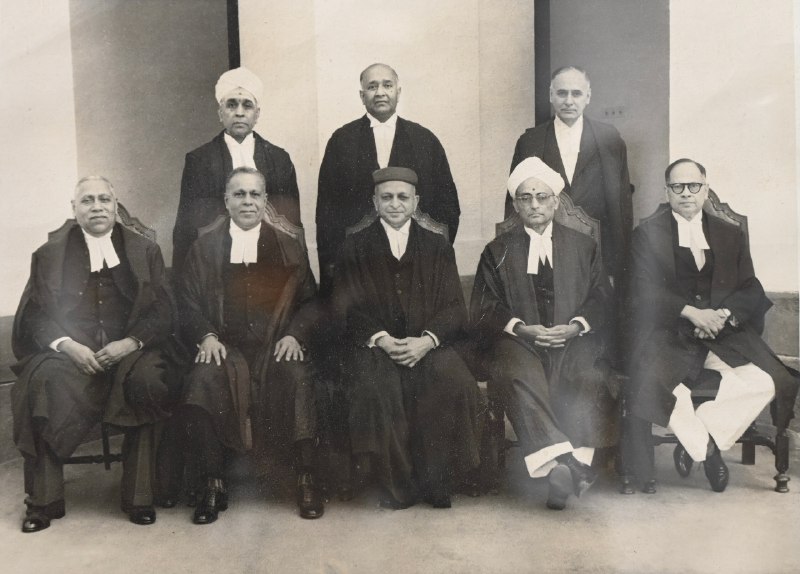
Aim of NCC 1A rare photograph of the first Chief Justice of India, Hon’ble Justice Harilal J.Kania with other Judges of the Supreme Court, 1950.
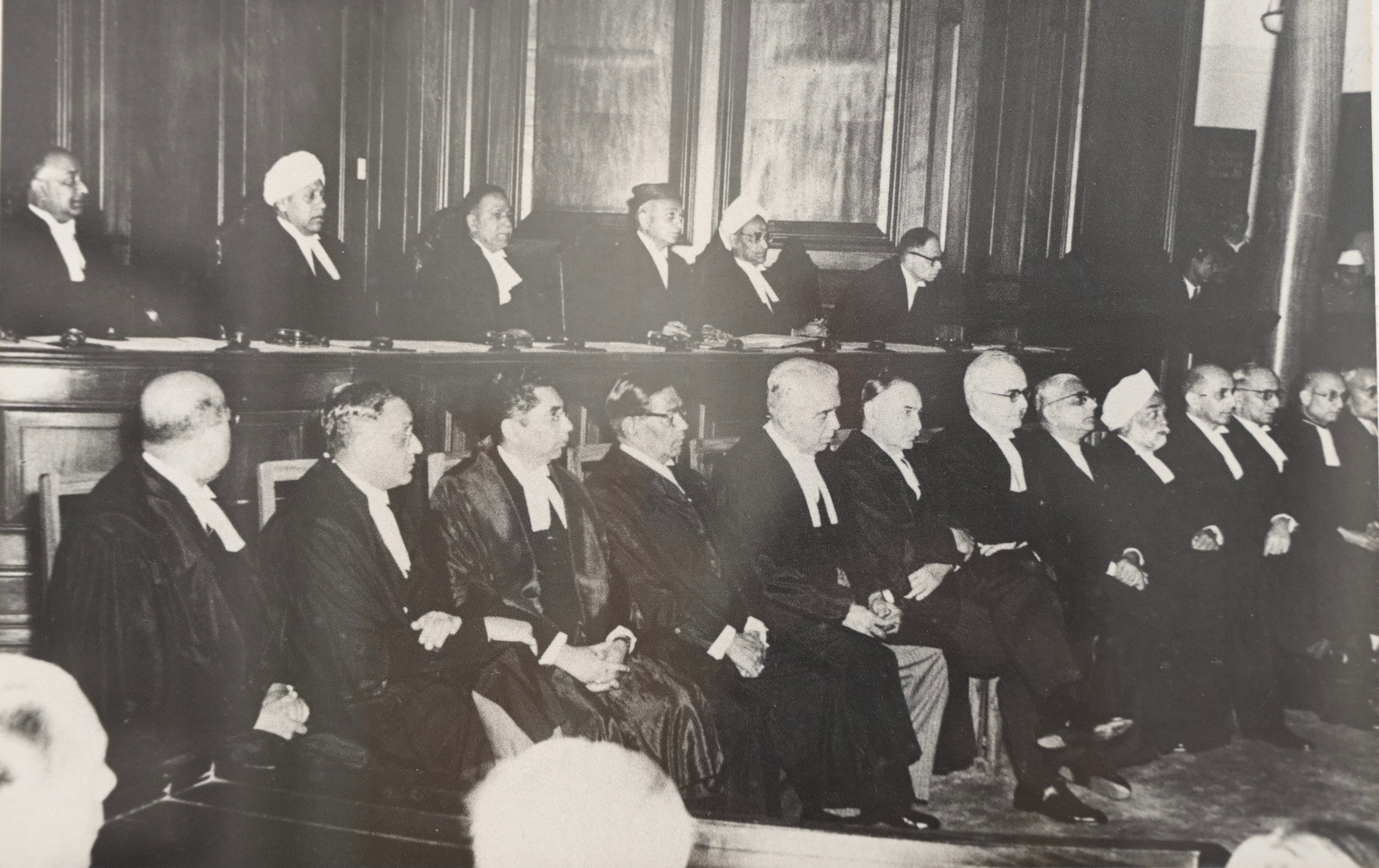
Aim of NCC 2The first Chief Justice of India, Hon’ble Justice Harilal J. Kania with other Judges of the Supreme Court on the dais and the Chief Justices of all High Courts on the inaugural sitting of the Supreme Court on 28 January 1950.
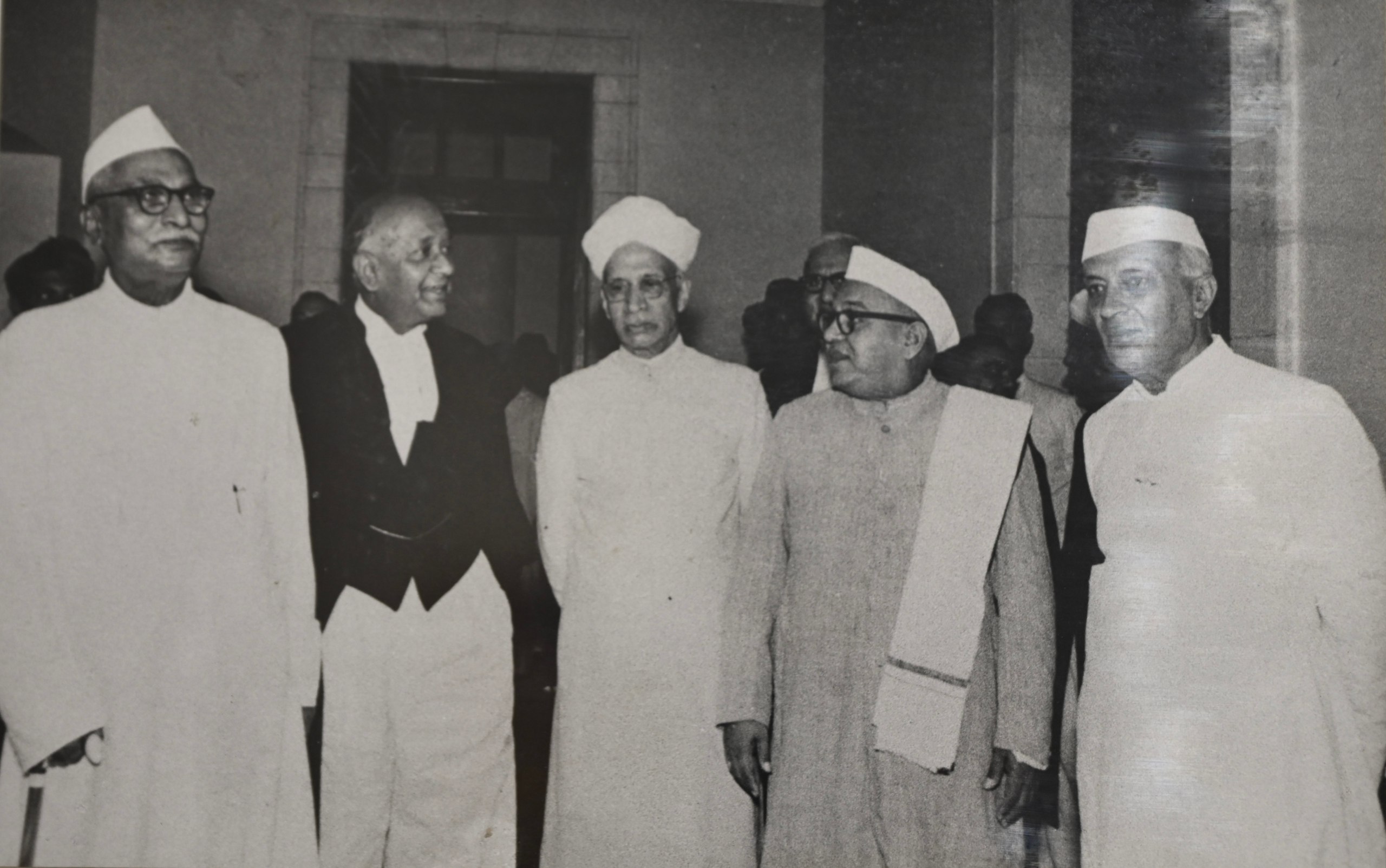
Aim of NCC 3(From the left) Dr. Rajendra Prasad, President of India, Shri S.R. Das, Chief Justice of India, Dr. S. Radhakrishnan, Vice-President of India, Shri Ananthasayanam Ayyangar, Speaker, Lok Sabha and Shri Jawaharlal Nehru, Prime Minister of India on the occasion of inauguration of the Supreme Court building on 4 August 1958..

JURISDICTION AND SEAT OF HIGH COURTS


JURISDICTION AND SEAT OF HIGH COURTS
S. No.Name of the High CourtYear of EstablishmentTerritorial JurisdictionPrincipal Seat & Bench
1.Bombay High Court1862Maharashtra,
Dadra and Nagar Haveli, Daman & Diu*,
Goa
Principal Seat : Mumbai
Other Benches : Panaji, Aurangabad, and Nagpur
2.Calcutta High Court1862West Bengal
Andaman & Nicobar islands*
Principal Seat : Kolkata
Other Benches : Port Blair and Jalpaiguri
3.Madras High Court1862Tamil Nadu
Pondicherry*
Principal Seat : Chennai
Bench : Madurai
4.Allahabad High Court1866Uttar PradeshPrincipal Seat : Prayagraj
Bench : Lucknow
5.Karnataka High Court1884KarnatakaPrincipal Seat : Bengaluru
Other Benches : Dharwad and Gulbarga
6.Patna High Court1916BiharPatna
7.Guwahati High Court1948Assam,
Nagaland,
Mizoram,
Arunachal Pradesh
Principal Seat : Guwahati
Other Benches : Kohima, Aizawl, and Itanagar
8.Odisha High Court1948OdishaCuttack
9.Rajasthan High Court1949RajasthanPrincipal Seat : Jodhpur
Bench : Jaipur
10.Madhya Pradesh High Court1956Madhya PradeshPrincipal Seat : Jabalpur
Other Benches : Gwalior and Indore
11.Kerala High Court1956Kerala, Lakshadweep*Kochi
12.Gujarat High Court1960GujaratSola(Ahmedabad)
13.Delhi High Court1966Delhi*New Delhi
14.Punjab & Haryana High Court1966Punjab, Haryana, Chandigarh*Chandigarh
15.Himachal Pradesh High Court1971Himachal PradeshShimla
16.Sikkim High Court1975SikkimGangtok
17.Chhattisgarh High Court2000ChhattisgarhBilaspur
18.Uttarakhand High Court2000UttarakhandNainital
19.Jharkhand High Court2000JharkhandRanchi
20.Tripura High Court2013TripuraAgartala
21.Manipur High Court2013ManipurImphal
22.Meghalaya High Court2013MeghalayaShillong
23.Telangana High Court2019TelanganaHyderabad
24.Andhra Pradesh High Court2019Andhra PradeshAmravati
25.Jammu & Kashmir and Ladakh
(Note: In 1928, Jammu & Kashmir high court was established. Post-bi-furcation of J&K into two Union Territories, there is now a common High Court.)
2019Jammu and Kashmir and Ladakh*Jammu & Srinagar

Distinction between "due process of law" and "procedures established by law"

The distinction between "due process of law" and "procedures established by law" lies in their scope, implications, and ...